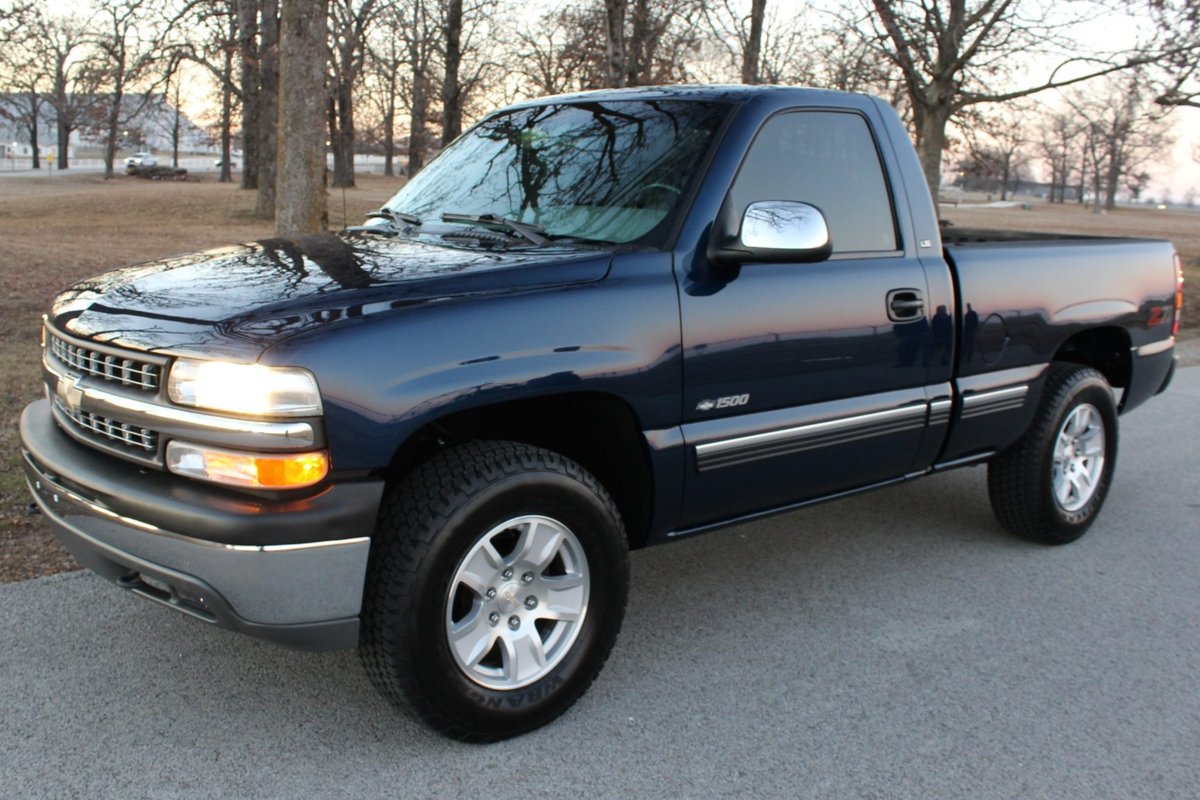
The year was 1998, and Chevrolet was about to redefine what a full-size pickup truck could be. Debuting for the 1999 model year, the First Generation Chevrolet Silverado (1999-2007) didn't just replace the venerable C/K series; it launched a new era of capability, comfort, and specialized performance, setting standards that competitors would chase for years. This wasn't merely an update; it was a ground-up transformation built on the robust GMT800 platform, designed to tackle everything from daily commutes to the toughest job sites with unprecedented poise.
At a Glance: The First-Gen Silverado Story
- Platform Powerhouse: Built on the all-new GMT800 architecture, delivering enhanced rigidity and ride quality.
- Model Years: Officially spanned from 1999 through 2007, with 2007 models branded "Classic" as the new generation debuted.
- Engine Revolution: Introduced modern LS-based V8s (4.8L, 5.3L, 6.0L) alongside a reliable 4.3L V6.
- Configurability: Offered a wide array of cab styles (regular, extended, crew) and bed lengths (short, standard, long).
- Specialized Variants: Spawned iconic models like the performance-oriented Silverado SS, the luxurious GMC Sierra Denali, and early Hybrid versions.
- Heavy-Duty Dominance: The 2500HD and 3500HD models brought formidable Duramax diesel and Vortec 8100 V8 power with Allison transmissions.
- Mid-Cycle Refresh: The "cateye" update in 2003 brought significant aesthetic and interior upgrades.
The Dawn of a New Era: From C/K to Silverado
Before 1999, "Silverado" was a familiar upscale trim level on Chevrolet's C/K trucks. But with the introduction of the GMT800 platform, it graduated to its own full-fledged model name, marking a distinct break from the past. Development for this ambitious program began in January 1993, with the design locked in by June 1995, culminating in production starting in June 1998.
Initially, GM kept the "classic" light-duty GMT400 C/K trucks in production alongside the new Silverado for the 1999 model year, easing the transition for loyal customers. Heavy-duty GMT400 pickups continued an even longer run, until 2000. This overlap subtly underscored the magnitude of the change: the GMT800 Silverado was stepping into big shoes, and it intended to fill them with a blend of rugged capability and refined driving dynamics never before seen in a mainstream American truck.
Built to Perform: Engines, Transmissions, and Chassis
The heart of the first-gen Silverado's performance lay in its powertrain options and robust chassis. From launch, buyers could choose between a dependable 4.3 L V6 or step up to an all-new lineup of LS-based V8 engines: the 4.8 L, 5.3 L, and the potent 6.0 L. These V8s, known for their durability and tunability, quickly became legends in their own right. A 5-speed manual transmission was available for those who preferred to row their own gears, though most models were paired with a smooth and robust 4-speed automatic.
GM didn't just focus on power; they also engineered a chassis designed for the long haul. The GMT800 platform was significantly more rigid than its predecessor, improving both ride comfort and handling. For 2001, a notable change occurred: all 2500 models received a torsion-bar front suspension, enhancing their heavy-duty credentials and providing a more controlled ride under load. This was a clear sign that GM was serious about engineering its trucks not just for utility, but for a superior driving experience across the board.
Crafting Your Ride: Cab, Bed, and Trim Options
One of the Silverado's greatest strengths was its incredible configurability, allowing buyers to tailor a truck precisely to their needs.
- Cab Styles: You could choose from a traditional 2-door standard/regular cab, ideal for work. For more passenger space, an extended cab was available, initially with 3 doors, then upgraded to a more practical 4-door design for the 2000 model year. Finally, recognizing the growing demand for family-friendly trucks, a full front-hinged 4-door crew cab, derived from the 2001 HD trucks, became available from 2004 onwards.
- Bed Lengths: Whether you needed maximum cargo capacity or a compact footprint, the first-gen Silverado had you covered with a 69.2-inch short box, a 78.7-inch standard box, and a lengthy 97.6-inch long box.
- Trim Levels: The Silverado offered a range of trims from the no-frills Base/SL, to the well-equipped LS/SLE, and the more luxurious LT/SLT. For the 2003 model year, a Work Truck (WT) trim was introduced, stripping away non-essential features for pure utility.
And for those who ventured off the beaten path, the legendary Z71 off-road package was available on 1500 4x4 models. This wasn't just a sticker; it included specific shock absorbers, jounce bumpers, stabilizer bars, robust skid plates, and a high-capacity air cleaner, transforming the Silverado into a formidable trail machine.
The Mid-Cycle Evolution: The "Cateye" Refresh (2003)
In the automotive world, mid-cycle refreshes are common, but the 2003 Silverado update—affectionately known by enthusiasts as the "cateye" design due to its distinctive headlamps—was particularly impactful. Introduced in 2002, this refresh wasn't just skin deep.
Visually, both the front and rear ends received significant updates, giving the Silverado a bolder, more modern appearance. Inside, the changes were even more profound. The interior dashboard was redesigned, as was the instrument cluster and steering wheel, enhancing ergonomics and aesthetics. Technology upgrades included new audio systems, with options like XM satellite radio, a premium Bose sound system, and a convenient 6-disc CD changer. This refresh helped keep the first-gen Silverado competitive and desirable well into its production run, proving that even a workhorse could benefit from a dose of modern style and tech.
Specialized Silverados: Performance, Luxury, and Efficiency
The first-generation Silverado wasn't content to be just a solid work truck. GM explored various niches, offering specialized variants that catered to performance enthusiasts, luxury seekers, and those looking for greater efficiency.
The Silverado SS: A Muscle Truck for the Modern Age
Launched in early 2003, the Silverado SS was Chevrolet's answer to the performance truck segment. Based on the 1500 Extended Cab with a 6.5-foot Fleetside box, it packed a serious punch: a 6.0-liter Vortec High-Output (LQ9) V8, churning out 345 hp and 380 lb·ft of torque. This power was channeled through a robust 4L65E four-speed automatic transmission and, initially, standard all-wheel drive with a 4.10 final drive. It also featured 4-wheel disc brakes and Z60 performance suspension, riding on distinctive 20-inch aluminum wheels.
A 2WD version was introduced in 2005, though it notably reverted to rear drum brakes as a cost-cutting measure, and AWD was dropped for all SS models in 2006. In 2006, Chevrolet honored racing legend Dale Earnhardt with the "Intimidator SS" special edition, boasting minor appearance upgrades that amplified its aggressive stance. The SS stands as a testament to the first-gen's versatility and its ability to be both a workhorse and a thrilling performance machine.
GMC Sierra Denali: Luxury and Innovation
Not to be outdone, GMC launched its upscale Sierra C3 in 2001, an even more refined take on the 1500 platform. This model came standard with all-wheel drive and shared the same potent 6.0 L Vortec 6000 LQ4 V8 as the early SS, producing 325 hp and 370 lb·ft.
In 2002, the C3 was renamed the Sierra Denali and introduced a groundbreaking feature: Delphi's Quadrasteer four-wheel steering system. Quadrasteer dramatically reduced the truck's turning radius, making tight maneuvers surprisingly easy for a full-size pickup, and significantly improved towing stability. While innovative, Quadrasteer was an expensive option and was dropped after 2004 for the Denali and from GM's entire lineup after 2005 due to poor sales. Despite this, the Denali carved out a niche for luxury and capability, rated for towing an impressive 10,000 pounds (4,500 kg) and hauling 1,840 pounds (830 kg).
Vortec Max / Performance Edition: Serious Towing Power
For those needing serious towing and hauling without the full HD designation, GM offered the Vortec High Output (VHO) / Performance Edition (B4V) package, introduced in 2004. This package delivered the powerful LQ9 6.0L V8 engine (345 hp, 380 lb·ft) to extended-cab standard-box 4x2 1500 series trucks. It included the Z60 High Performance suspension, the robust 4L65E transmission, a 3.73 rear gear, and an Eaton locking differential. 2005 models received an even stronger 14-bolt 9.5" rear end.
In 2006, this package evolved into the Vortec Max (NHT) trailering package, retaining the LQ9/4L65-E powertrain but paired with a Z85 Handling/Trailering suspension and 17-inch wheels. This setup was specifically optimized for high-capacity trailer towing, allowing these light-duty trucks to pull up to an astonishing 10,800 pounds.
Parallel Hybrid Truck (PHT): An Early Glimpse into the Future
In 2004, GM dipped its toes into hybrid technology with the Parallel Hybrid Truck (PHT). This micro-hybrid system was a subtle but significant step, using an electric motor primarily for engine cranking, battery charging, and accessory power. It allowed the 5.3 L LM7 Vortec 5300 V8 to shut down at stops, restarting seamlessly with 42-volt electric power. The PHT also featured three additional 14-volt VRLA batteries and, innovatively, four 120-volt 20-ampere AC outlets, turning the truck into a mobile power station—a massive benefit for contractors and campers alike. Initially targeting commercial buyers, retail availability expanded from 2005 to 2007, demonstrating GM's early commitment to exploring more efficient powertrains, even if the PHT itself was discontinued for the 2008 model year.
Heavy Duty Power: The 2500HD and 3500 Lines
When the job called for extreme capability, the first-generation Silverado answered with its Heavy Duty (HD) lineup: the 1500HD, 2500HD, and 3500 models, introduced for the 2001 model year. These trucks were engineered from the ground up to tackle the most demanding tasks.
The 1500HD, introduced for 2001, filled a unique niche. It featured a strong Vortec 6000 V8 (300 hp, 360 lb·ft) and the heavy-duty Hydra-Matic 4L80-E transmission, exclusively offered in a crew-cab, standard-box configuration. It was briefly rebadged as the 2500 model in 2004 before returning to 1500HD status in 2005.
But the true titans were the 2500HD and 3500, offering formidable engine choices:
- Duramax Diesel V8s: These powerhouses evolved through several iterations (LB7, LLY, LBZ), with output climbing from 300 hp/520 lb·ft to an impressive 360 hp/650 lb·ft by the end of the generation.
- Vortec 8100 V8: For those preferring gasoline power, the massive 8.1 L Vortec 8100 V8 delivered 340 hp and 455 lb·ft of torque.
These potent engines were paired with equally robust transmissions, most notably the legendary 5-speed (later 6-speed for 2006–2007) Allison 1000 automatic, a name synonymous with durability in the heavy-duty segment. The 3500 model often featured dual rear wheels and a significantly stronger suspension, specifically designed for maximum stability and hauling.
Their towing capacities were truly staggering for their time: the 1500HD could pull up to 10,300 pounds (4,700 kg), the 2500HD stretched that to 16,100 pounds (7,300 kg), and the mighty 3500 could handle an astounding 16,700 pounds (7,600 kg). These numbers solidified the first-gen HD Silverados as benchmarks for capability in the truck world.
Common Questions About the First-Gen Silverado
As a defining truck of its era, the first-generation Silverado often sparks a few questions, especially for those considering one today.
What does "Classic" mean for 2007 models?
When the all-new second-generation Chevrolet Silverado (GMT900 platform) debuted for the 2007 model year, GM continued to produce the older GMT800 platform trucks for a portion of that year. To distinguish them, these outgoing models were branded "Classic." So, if you see a 2007 Silverado "Classic," it refers to the first-generation GMT800 design, not the newer second-gen.
Why were some features discontinued, like Quadrasteer?
Innovative features like Quadrasteer, while technically impressive, often face the harsh reality of market demand and cost. Quadrasteer added significant complexity and expense to the Denali and other GM trucks, and despite its benefits in maneuverability and towing, sales didn't justify its continued production. Similarly, the reintroduction of rear drum brakes on some 2005 1500 models (excluding Hybrid and Denali) was a cost-cutting measure, highlighting the constant balance manufacturers strike between features and affordability.
Why the First-Gen Silverado Still Matters
The First Generation Chevrolet Silverado wasn't just another truck; it was a pivotal moment for General Motors and the entire pickup truck segment. It successfully shed the legacy of the C/K series while building upon its reputation for toughness. With its comfortable and spacious cabins, powerful and efficient LS-based V8 engines, and truly specialized variants like the SS and HD models, it cemented the Silverado's place as a dominant force.
This generation defined new benchmarks for ride quality, interior refinement, and outright capability. It proved that a pickup truck could be both a rugged work tool and a comfortable daily driver, adaptable to a multitude of lifestyles and professions. Even today, these trucks are highly sought after in the used market, a testament to their enduring quality, ease of maintenance, and the robust engineering GM poured into the GMT800 platform. Their continued presence on roads and job sites is a powerful endorsement of their original design and construction.
Beyond the First Generation: The Silverado's Enduring Legacy
The first-generation Silverado laid a formidable groundwork, paving the way for the truck's continued evolution. Subsequent generations built upon this strong foundation, introducing further advancements in technology, efficiency, and capability. The second-generation (GMT900) brought electronic stability control and improved aerodynamics; the third-generation (K2XX) introduced advanced EcoTec3 engines; and the current fourth-generation (T1) leverages mixed materials for weight reduction and boasts astounding towing figures up to 35,500 pounds for HD models. Chevrolet also expanded its horizons, entering the medium-duty market with trucks like the 4500HD.
Each iteration, including the trailblazing original, has contributed to the Silverado's iconic status in the truck world. To truly appreciate how far this nameplate has come, you can Explore Silverado generations and trace its journey from its C/K roots to the sophisticated, high-performance, and incredibly capable trucks of today. The first-gen Silverado remains a beloved classic, a workhorse with a touch of modern class that continues to serve its owners well, proving that some standards, once set, endure for decades.